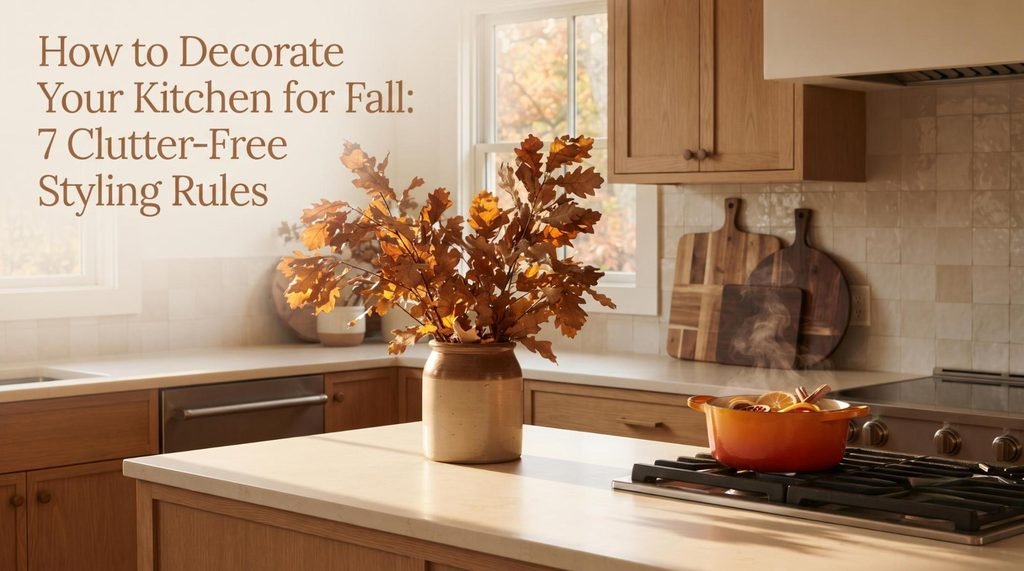
When autumn arrives, the kitchen naturally re-emerges as the bustling, aromatic center of home life. Between morning coffee rituals, baking seasonal breads, and simmering slow evening meals, our kitchens work harder during the fall than at any other time of the year.
However, translating the cozy charm of the season into a kitchen presents a distinct design challenge. Unlike a living room mantel or an entryway console table, kitchen countertops are primary work surfaces. Scattering decorative pumpkins, plastic foliage, and fragile knick-knacks across chopping zones quickly results in visual chaos and physical frustration.
Decorating your kitchen for fall does not require buying disposable holiday decor or sacrificing functional food-prep space. By grounding your design in professional interior color formulas, vertical spatial layering, foraged natural elements, and ambient lighting, you can cultivate a rich, inviting autumn atmosphere that remains effortless to cook in every day.
📌 Love these seasonal styling rules? Hover over any image in this guide and click the red Save button to pin it directly to your Pinterest Home Decor Board for easy reference!
In This Guide
- The Philosophy of Functional Seasonal Styling
- Rule 1 — Apply the 60-30-10 Autumn Color Formula
- Rule 2 — Master the Triangle Vignette Method on Countertops
- Rule 3 — Layer Backsplashes Vertically to Preserve Counter Depth
- Rule 4 — Bring the Outdoors In with Natural Foraging & Produce
- Rule 5 — Engage the Senses with Autumn Simmer Pots and Warm Spices
- Rule 6 — Layer Tactile Natural Textiles and Woven Fibers
- Rule 7 — Shift to Intimate Low-Level Ambient Lighting
- 4 Fall Kitchen Decor Mistakes to Avoid
- Frequently Asked Questions About Fall Kitchen Decor
The Philosophy of Functional Seasonal Styling
Professional interior styling in high-utility rooms relies on one fundamental premise: Decor should enhance the environment, not obstruct its purpose.
In a kitchen, every object sitting on a counter must earn its place. The secret to an elevated autumn aesthetic lies in using items that fulfill a practical cooking function while contributing tactile warmth, rich organic color, and seasonal fragrance. When you style with authentic materials—such as solid hardwoods, stoneware ceramics, raw linen, and fresh orchard harvest—the kitchen feels naturally transformed rather than artificially decorated.
Rule 1 — Apply the 60-30-10 Autumn Color Formula
A common decorating mistake is attempting to inject fall colors by scattering saturated orange everywhere. High-end interior design uses the classical 60-30-10 color ratio to establish harmonious visual balance without overwhelming the eye.
Establishing the 60% Warm Neutral Foundation
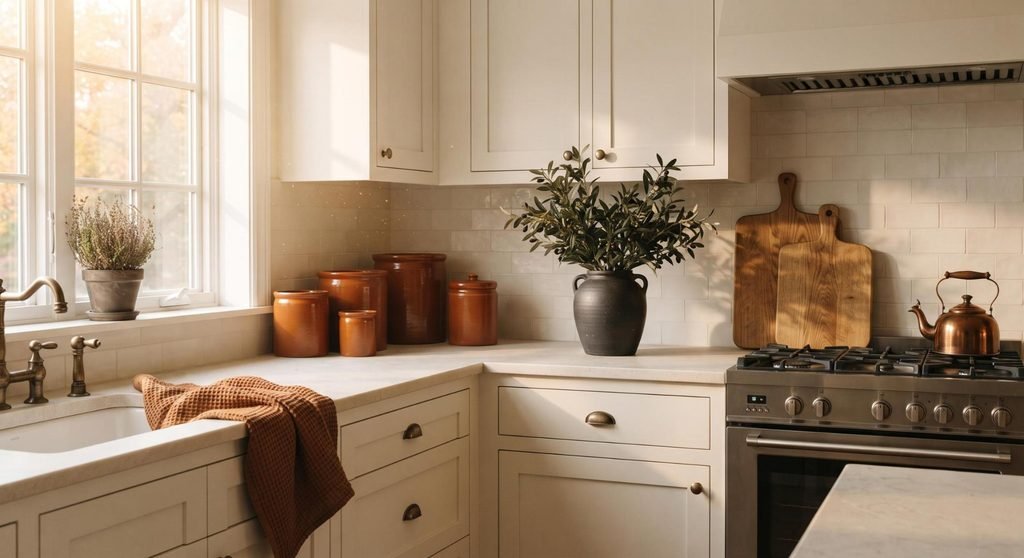
Your dominant 60% consists of the kitchen’s architectural background: off-white or light wood cabinetry, creamy plaster walls, neutral stone countertops, and natural flooring. This neutral base provides the quiet breathing room that lets seasonal accents stand out cleanly.
Infusing 30% Secondary Earth Tones (Terracotta, Rust & Ochre)
Your 30% secondary tone brings autumnal warmth into the mid-ground. Introduce this through warm timber cutting boards, rich amber glass dispensers, terracotta planters, ochre dish towels, and natural stoneware pottery.
Distributing 10% High-Contrast Accents (Deep Olive & Muted Brass)
Your final 10% provides visual punctuation. Use deep forest green foliage, antique brass hardware, matte black cast iron cookware, and dark bronze accents to anchor the lighter wood tones and add sophisticated depth.
Rule 2 — Master the Triangle Vignette Method on Countertops
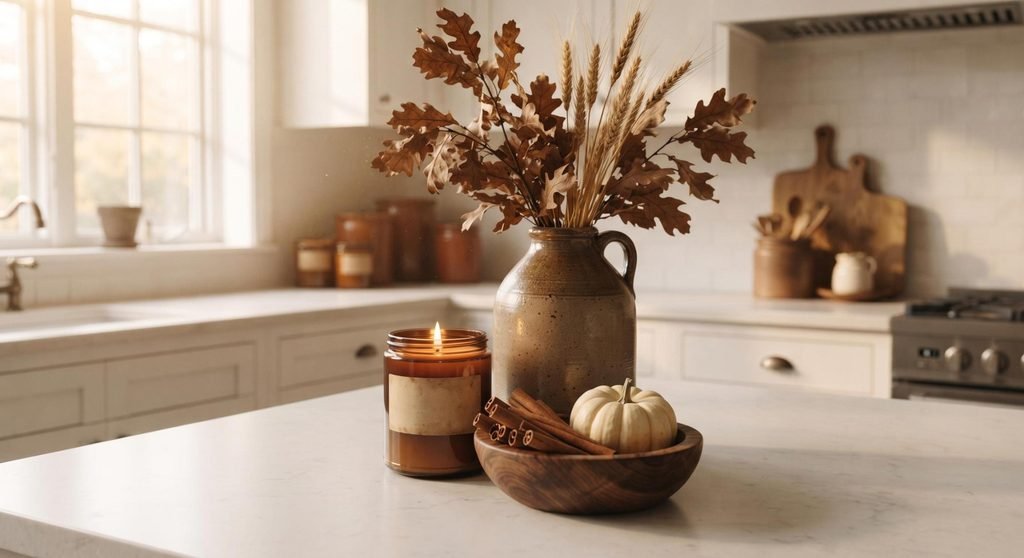
To keep countertops functional, decorative arrangements must be strictly contained within compact “islands” rather than lined up across backsplashes. The Triangle Vignette Method arranges three objects of varying heights to create a balanced, dynamic grouping.
Establishing the Visual Anchor (Height)
The tallest element of your triangle serves as the visual anchor and sits at the back. This could be a tall ceramic pitcher holding foraged branches, an architectural pepper mill, or an arched cutting board leaning against the wall.
Adding the Functional Middle Layer (Mid-Height)
The secondary element sits slightly forward and to the side, bridging the height gap. An artisanal salt cellar, a scented amber glass candle, or a stack of stoneware coffee mugs works perfectly here.
Grounding the Arrangement with Low Textures (Base)
The final piece sits at the front corner, completing a visual triangle. A small dish of sea salt, a petite raw wooden bowl, or a single sculptural mini gourd grounds the vignette without sprawling onto food prep surfaces.
Rule 3 — Layer Backsplashes Vertically to Preserve Counter Depth
Horizontal counter space is precious. The vertical space against your tile backsplash, however, is often completely underutilized. Layering flat, textural kitchen items upright against walls introduces warmth without consuming more than two inches of counter depth.
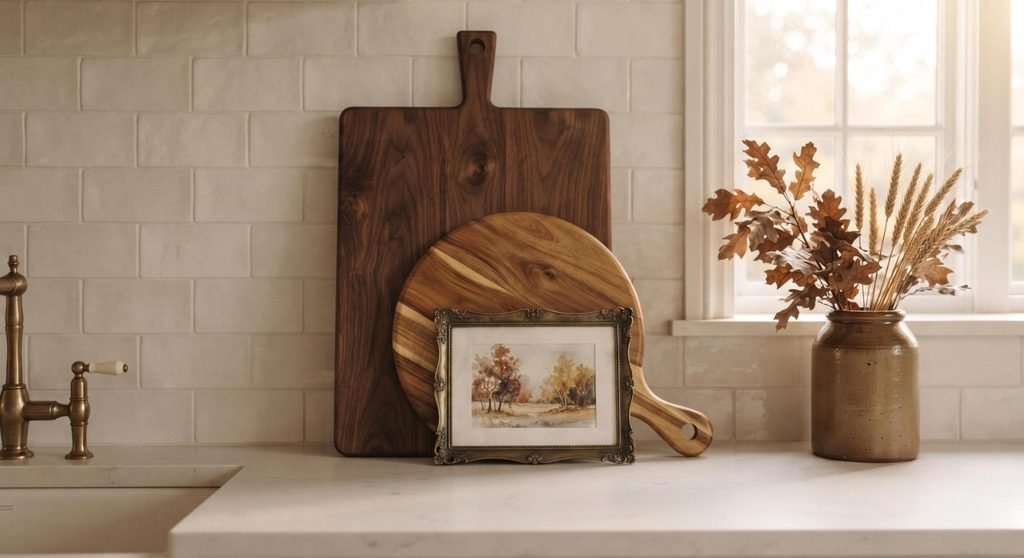
Staggering Contrasting Wood Cutting Boards
Create an artisanal backdrop by leaning two or three cutting boards of differing shapes, sizes, and timber species. Place a tall rectangular board at the back, overlap it at an angle with a round paddle board, and finish with a small contrasting marble or dark walnut prep board.
Leaning Framed Botanical Art and Vintage Linen Prints
Tuck a small vintage brass frame holding a muted autumn landscape painting or botanical sketch behind your cutting board stack. This adds refined gallery texture to stark subway tile while concealing electrical outlets.
Rule 4 — Bring the Outdoors In with Natural Foraging & Produce
The most authentic autumn decor is living and perishable. Replacing artificial plastic garlands with foraged botanical branches and edible seasonal produce delivers texture and color that synthetic items cannot replicate.
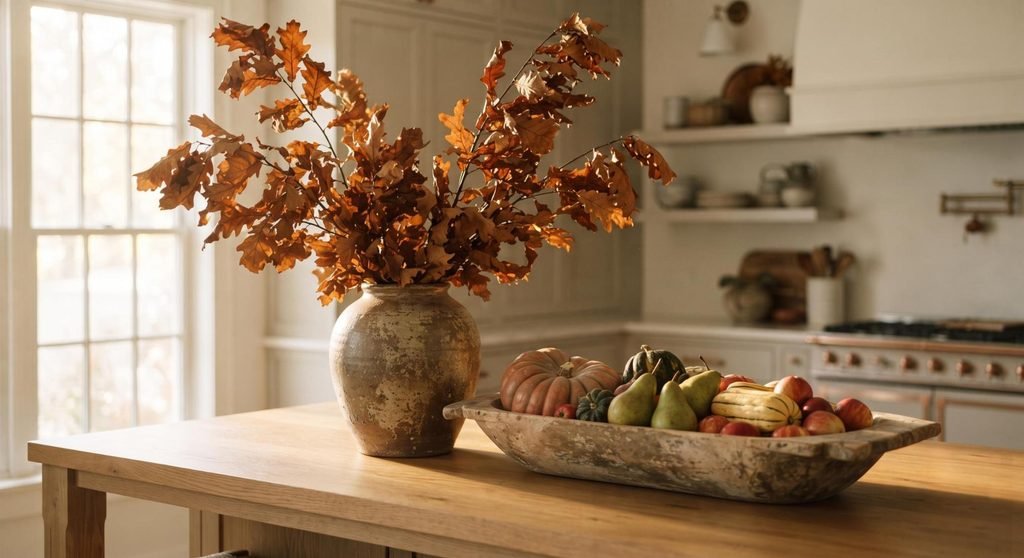
Foraging Architectural Dried Oak, Beech, and Berry Stems
Clip three to five tall, architectural branches from outdoors—such as dried oak with turning brown leaves, red rosehip branches, or seeded eucalyptus. Arrange them organically in a heavy stoneware vase so they reach upward toward the ceiling, creating dramatic height without spreading across counter width.
Styling Heirloom Squash, Pears, and Orchard Apples in Wooden Bowls
Rather than buying resin pumpkins, fill a large footed wooden bowl or woven basket with edible heirloom produce: ribbed Fairytale pumpkins, knobby butternut squash, Bosc pears, and deep red Honeycrisp apples. This creates a stunning organic centerpiece that transitions directly into weeknight dinners.
Rule 5 — Engage the Senses with Autumn Simmer Pots and Warm Spices
Seasonal styling extends beyond what you see—it encompasses how the kitchen smells and sounds. A natural stovetop simmer pot fills the home with comforting autumn aroma without artificial chemical fragrances or cloying synthetic room sprays.
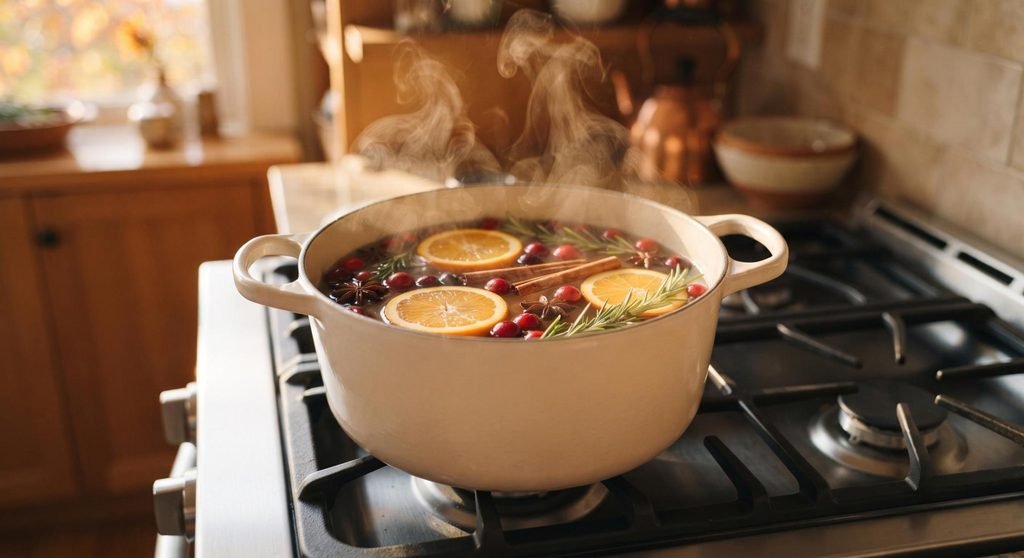
Crafting Natural Stovetop Aromas (Cinnamon, Clove & Orange Peel)
In a small enameled cast iron saucepan or glass pot, combine sliced fresh oranges, whole cinnamon sticks, star anise, a dash of whole cloves, and a fresh sprig of rosemary. Fill with water and let it simmer on the lowest stove burner setting, adding water periodically to maintain a continuous, comforting aroma.
Displaying Whole Spices in Clear Glass Apothecary Jars
Decant whole nutmeg seeds, cinnamon quills, and dried bay leaves into small clear glass jars with wooden lids on open coffee station shelves. Their rich natural colors and raw textures double as beautiful, functional pantry styling.
Rule 6 — Layer Tactile Natural Textiles and Woven Fibers
Tactile textures soften the hard, reflective surfaces of stone, tile, and stainless steel. Swapping your standard textiles for heavy natural weaves introduces seasonal comfort underfoot and at the sink.
Swapping Flat Towels for Dimensional Waffle and Slub Linen
Replace printed microfiber cloths with heavyweight 100% cotton waffle-weave towels or washed slub linen in shades of toasted rust, sage olive, and warm camel. Draped casually over an oven handle or apron-front sink, the dimensional honeycomb weave catches the light and adds rich tactile depth.
Anchoring Hard Floors with Natural Jute and Flatweave Runners
Lay a durable, natural jute or wool flatweave runner between your kitchen island and sink. The rich, earthy weave cushions footsteps during long meal prep sessions while insulating cold morning floors.
Rule 7 — Shift to Intimate Low-Level Ambient Lighting
Lighting dictates mood. Bright overhead pot lights are essential for chopping vegetables, but once cooking concludes, harsh ceiling lights should be turned off in favor of warm, low-level illumination.
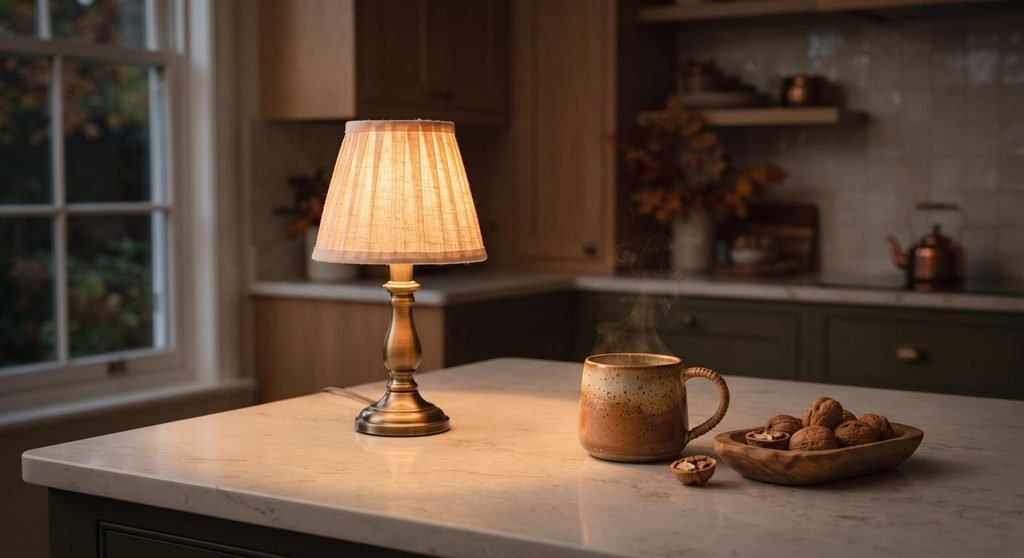
Switching Task Lighting to Warm 2700K Color Temperatures
Ensure under-cabinet lights and pendant fixtures use bulbs rated at 2700K (Soft Warm White). This replicates the golden, amber glow of late-afternoon sunlight, softening sharp counter edges and creating an inviting dinner ambiance.
Introducing Cordless Accent Lamps and Timer-Controlled Glow
Place a small, cordless rechargeable table lamp with an amber or fabric shade in an unused corner of the counter or atop a floating shelf. Paired with a timer-controlled warm LED candle, it casts an intimate, restaurant-style evening glow across the kitchen.
4 Fall Kitchen Decor Mistakes to Avoid
- Crowding the Kitchen Work Triangle: Never place decor between the primary path connecting your sink, refrigerator, and stovetop. Keep work zones strictly clear.
- Using High-Gloss Plastic Pumpkins: Synthetic neon orange plastics look cheap and clash with natural kitchen materials. Opt for genuine heirloom squash or matte stoneware.
- Spreading Decor in a Straight Line: Lining small items along the back edge of countertops creates clutter. Always group accents into tight, contained triangles or pedestal trays.
- Ignoring Scale and Proportion: Scattering numerous tiny knick-knacks creates visual noise. Choose one or two tall, high-impact statements—such as a large vase of tall foraged branches—over dozens of small trinkets.
Frequently Asked Questions About Fall Kitchen Decor
When should you start decorating your kitchen for fall?
Late September to early October—as the autumn equinox arrives—is the ideal window. Transitioning textiles, cutting boards, and foraged branches early in the season creates a cozy environment that remains relevant through Thanksgiving.
How do you make a white modern kitchen feel warm for fall?
Incorporate natural wood cutting boards, dark amber glass soap bottles, terracotta vessels, rust-colored waffle-weave towels, and warm 2700K ambient lighting to counterbalance cool white cabinetry and quartz counters.
How do I decorate a very small kitchen for fall without losing counter space?
Focus purely on vertical surfaces and functional swaps: lean wooden cutting boards vertically against the backsplash, hang a rust linen towel on the oven handle, style a simmer pot on the stove, and place foraged branches atop the refrigerator or a high floating shelf.
Final Thoughts
Styling your kitchen for autumn is not about filling every surface with store-bought seasonal novelties. It is about honoring the rhythm of the season through warm, earthy color palettes, rich timber textures, foraged outdoor greenery, and comforting natural scents.
By applying spatial containment rules and letting functional kitchen items double as seasonal focal points, you create a space that feels deeply welcoming, peaceful, and ready for memorable autumn meals.
📌 Ready to style your kitchen? Save this guide to your Pinterest Home Decor Board so you have these 7 design rules and color formulas handy when autumn arrives!
You May Also Like