Living with a bathroom that lacks a built-in linen closet or built-in cabinetry is one of the most common organizational challenges in apartments, older homes, and compact powder rooms. When you have nowhere to stash extra towels, bulk toilet paper packs, or daily toiletries, countertops quickly become crowded catchalls, and morning routines feel chaotic.
However, a cluttered bathroom is rarely a square-footage problem—it is almost always a systems problem. Adding random plastic bins without a clear spatial plan simply creates organized clutter.
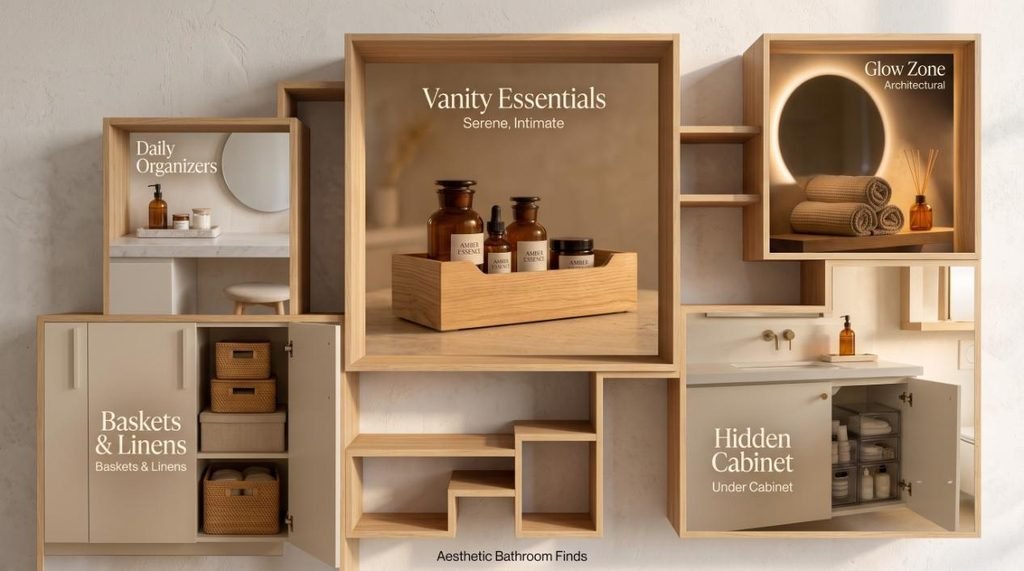
To transform a closetless bathroom into an efficient, serene space, you need a systematic organizational framework. By implementing the 5-Zone Bathroom Framework, auditing your physical inventory by frequency of use, and enforcing boundary rules for bulky items, you can create a functional, spa-like environment regardless of room size.
📌 Love these bathroom organization tips? Hover over any image in this post and click the red Save button to pin it directly to your Pinterest Home Organization Board for easy reference later!
In This Guide
- Step 1: The Initial Audit & Aggressive Declutter
- Step 2: Categorization by Frequency of Use
- Step 3: The 5-Zone Bathroom Framework
- Step 4: Visual Decluttering & Decanting Rules
- Step 5: Strategies for Managing Bulky Essentials
- Step 6: The 2-Minute Daily Reset Habit
- Frequently Asked Questions
- Final Thoughts & Organization Checklist
Step 1: The Initial Audit & Aggressive Declutter
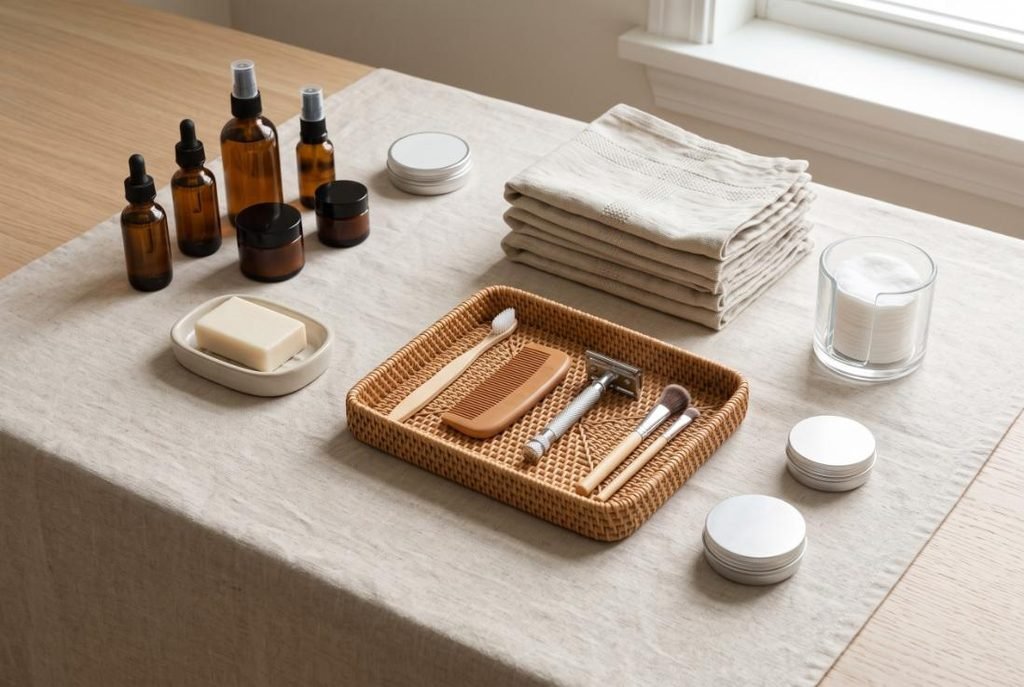
Before buying organizers or assigning items to zones, you must remove everything from the room. A successful decluttering session requires evaluating every single item on a flat, neutral surface (such as a dining table or bed).
Tossing Expired Skincare, Cosmetics, and Old Medications
Bathroom humidity and temperature fluctuations accelerate the degradation of active cosmetic formulas and topical treatments. Discard items that fall into these categories immediately:
- Sunscreen & SPF: Sunscreens past their expiration date lose their UV protection filters.
- Liquid Makeup & Mascaras: Any liquid eye product open for longer than 6 months harbors bacterial buildup.
- Active Serums: Vitamin C and retinol formulas that have oxidized (turned dark yellow or brown) or changed scent.
- Expired Medications: Take expired prescription and over-the-counter pain relievers to a local pharmacy disposal drop-box.
The One-Bottle Rule: Consolidating Half-Empty Duplicates
Multiple half-empty bottles of shampoo, body wash, and duplicate lotions consume valuable cabinet volume. Enforce the One-Bottle Rule: keep only one open container of each product category in the bathroom at any given time. Store unopened backups in a secondary storage area outside the bathroom, or consolidate identical formulas into a single bottle.
Step 2: Categorization by Frequency of Use
The key to keeping a small bathroom organized long-term is separating items by how often you touch them, rather than grouping everything by broad category.
Tier 1: Daily Morning and Evening Essentials
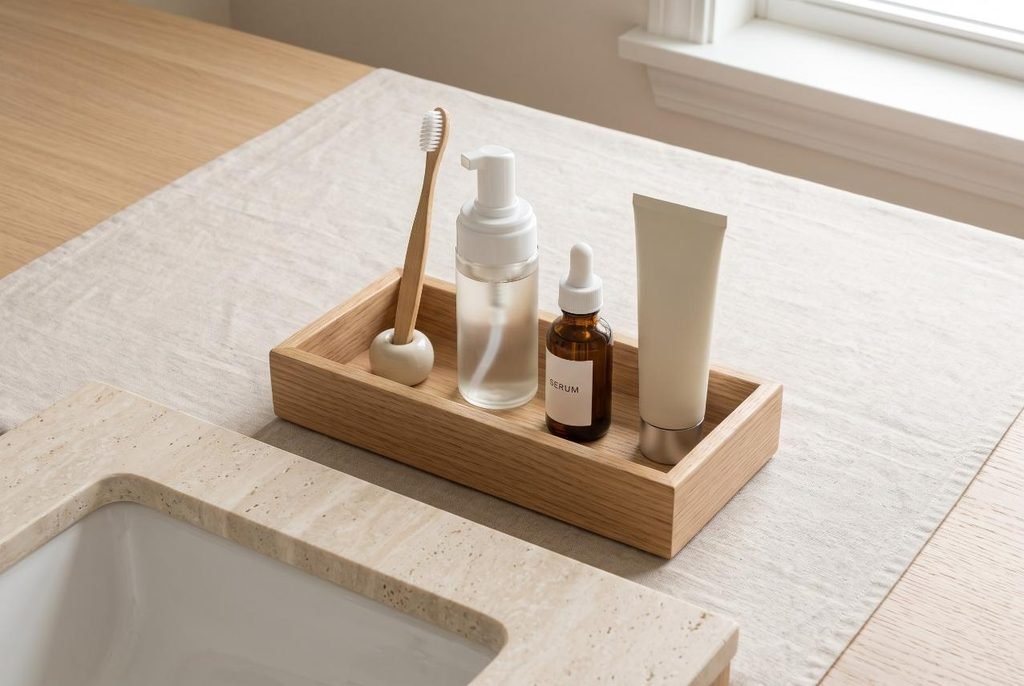
These are the non-negotiables you use twice every day: toothbrush, toothpaste, daily facial cleanser, moisturizer, deodorant, contact lens supplies, and everyday prescription medicine. These items belong in the most accessible prime real estate zones.
Tier 2: Weekly Regimens and Treatment Products
Items used 1 to 3 times per week: exfoliating scrubs, deep conditioning hair masks, sheet masks, manicure tools, and special shaving supplies. These should be kept together in a single portable caddy or bin that is easy to pull out and put away.
Tier 3: Occasional Reserves and Bulk Backstock
Unopened backup shampoo, bulk bars of soap, spare razor cartridges, and extra dental floss. In a bathroom with no closet, Tier 3 inventory should be kept to a strict minimum (1 backup per category) or stored in an adjacent hallway closet.
Tier 4: First Aid and Emergency Medicine
Bandages, antiseptic sprays, thermometers, burn creams, and cold medicine. Because these are needed unpredictably, group them into a clearly labeled, moisture-sealed container placed on an upper shelf away from shower steam.
Step 3: The 5-Zone Bathroom Framework
The 5-Zone Framework organizes your bathroom by mapping daily movements and physical boundaries to prevent spatial bottlenecks.
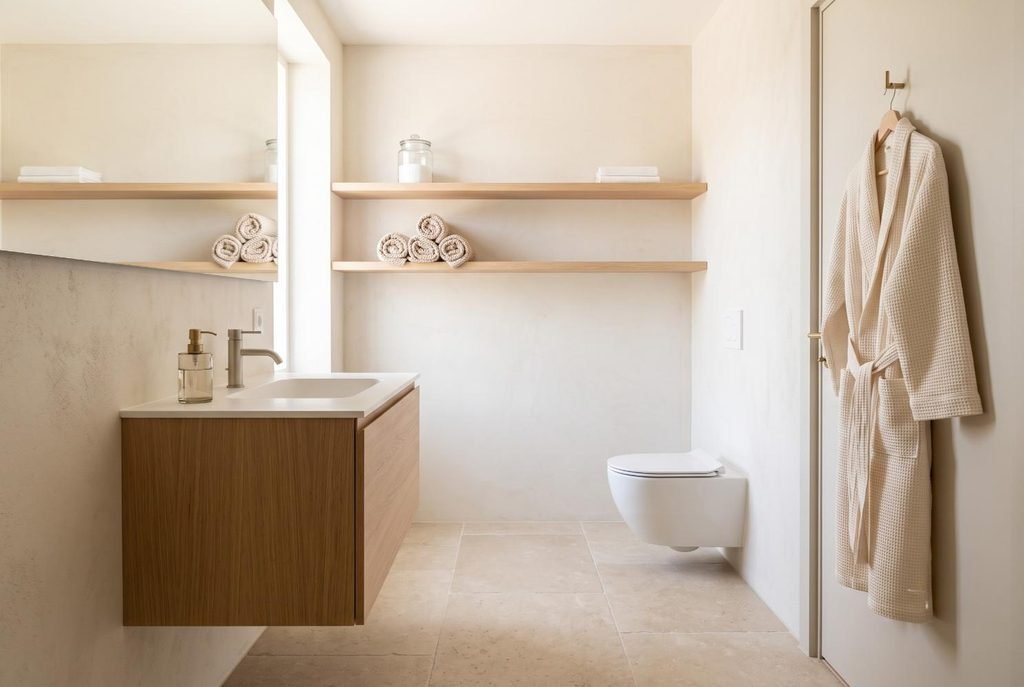
Zone 1: Prime Countertop & Eye-Level Real Estate
- Location: The vanity countertop surface and immediate eye-level shelf space.
- Rule: Enforce a strict Maximum 3-Item Limit on open countertops. Leaving more than three loose objects on a small vanity creates instant visual clutter and makes wiping down water splashes frustrating.
- Ideal Contents: Hand soap dispenser, a small stone tray holding daily rings or a watch, and an ambient accent (such as a bud vase or small apothecary canister for cotton swabs).
Zone 2: Vertical Over-Toilet & Wall Planes
- Location: The vertical space 24 to 72 inches above the toilet tank and open wall expanses.
- Rule: Maximize upward capacity using wall-mounted closed cabinetry or deep wooden floating shelves.
- Ideal Contents: Clean rolled bath sheets, decorative apothecary jars for cotton rounds, extra hand towels, and discreet tissue box covers.
Zone 3: Under-Sink & Low Cabinet Cavities
- Location: The dark cabinet or open space beneath the bathroom sink basin.
- Rule: Use modular, tiered sliding drawers that wrap around the centered plumbing P-trap pipe.
- Ideal Contents: Heavy cleaning sprays, extra liquid soap refills, hair styling tools (hair dryers, straighteners), and categorized acrylic pull-out drawers for grooming backups.
Zone 4: The Wet Zone (Shower & Tub Perimeters)
- Location: Inside the shower enclosure or bathtub surround.
- Rule: Lift all bottles off the shower floor, tub ledges, and window sills.
- Ideal Contents: Use rustproof adhesive caddies or built-in niches to hold only current daily shower items: 1 shampoo, 1 conditioner, 1 body wash, and 1 razor per person.
Zone 5: The Hidden Perimeter (Doors & Narrow Gaps)
- Location: The back of the bathroom door and the 5-to-8-inch floor gap between the vanity and wall.
- Rule: Utilize vertical hanging rails and ultra-slim rolling slide-out carts for high-density, low-visibility storage.
- Ideal Contents: Heavy bath sheets, bathrobes, extra toilet paper rolls, and hair wraps.
Step 4: Visual Decluttering & Decanting Rules
Visual clutter creates cognitive friction. How items look when stored matters just as much as where they are placed.
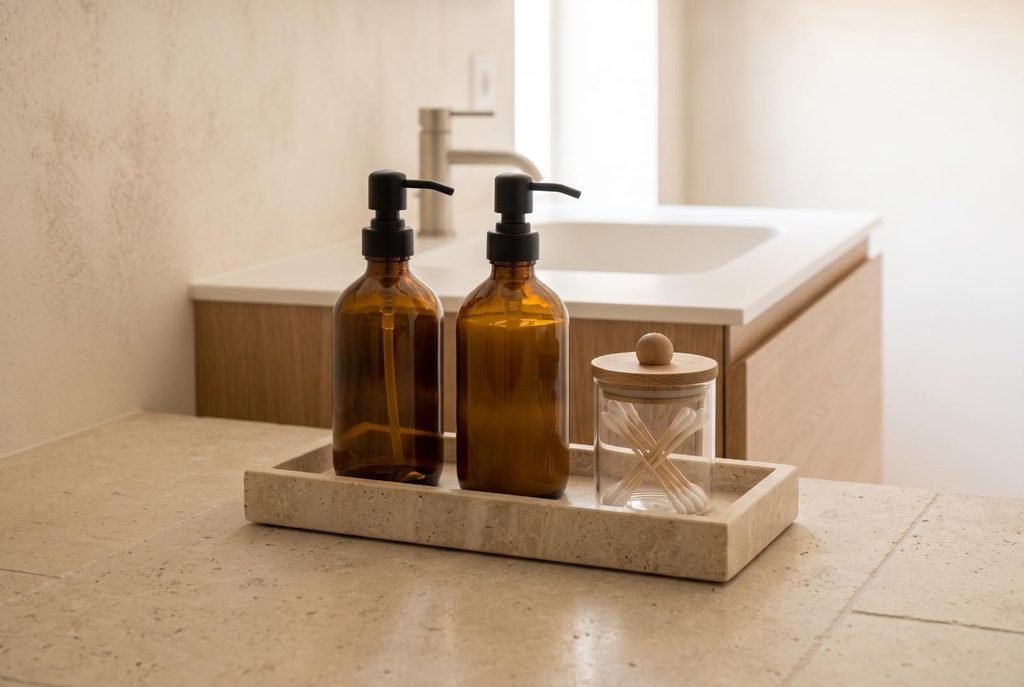
The 80/20 Concealment Ratio
In a small bathroom, aim for an 80/20 balance:
- 80% Concealed Storage: Keep cleaning supplies, feminine hygiene items, medication, backup bottles, and electronic hair tools hidden behind closed cabinet doors, inside drawers, or within solid fabric/rattan bins.
- 20% Curated Display: Reserve open shelves for aesthetically pleasing items with unified textures (neutral waffle towels, clear glass canisters, wooden brush handles).
Clear vs. Opaque Storage Theory
- Use Clear Bins Inside Closed Cabinets: When organizing inside an under-sink vanity cabinet or closet drawer, transparent acrylic bins allow you to see inventory levels instantly, preventing duplicate purchases.
- Use Opaque Bins on Open Shelves: When organizing open over-the-toilet shelves or exposed wall ledges, use solid matte white, woven rattan, or canvas bins to conceal mismatched packaging and create clean horizontal sightlines.
Step 5: Strategies for Managing Bulky Essentials
Bulky bathroom necessities—specifically bath towels and multi-pack toilet paper—consume the most volume in a small room.
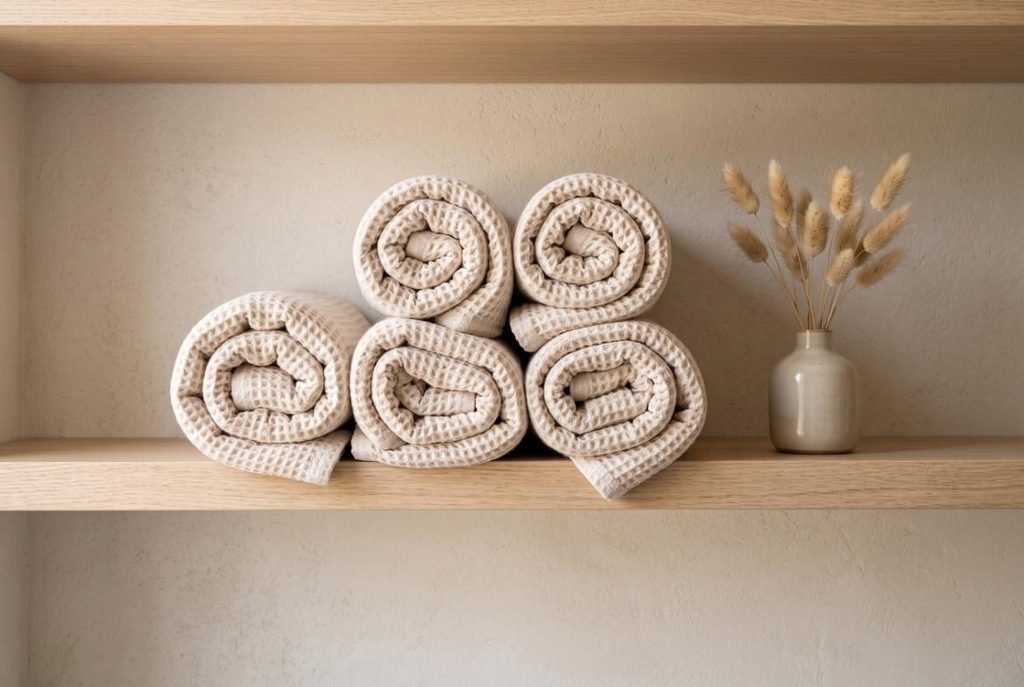
The 2-Towel Rule per Person
In a home without a dedicated linen closet, storing six to eight oversized bath sheets in the bathroom is unsustainable. Adopt the 2-Towel Rule: allocate exactly two bath sheets and two hand towels per household member (one in active use, one clean backup).
To save shelf depth, roll clean towels into tight cylinders instead of folding them into wide rectangles. Rolled towels take up 30% less shelf depth and create a clean, hotel-inspired look.
Storing Toilet Paper Reserves Without a Linen Closet
Never leave loose plastic-wrapped bulk packages of toilet paper on the floor. Manage paper goods with these three compact tactics:
- Vertical Stand Dispensers: Use a slim, freestanding metal canister or holder next to the toilet that stores 3 to 4 rolls vertically.
- Top Shelf of Closed Cabinetry: Dedicate the highest shelf of your over-the-toilet cabinet specifically to paper reserves.
- Slim Slide-Out Carts: A 5-inch wide rolling cart tucked beside the toilet can hold up to 8 rolls out of sight.
Step 6: The 2-Minute Daily Reset Habit
The most thoughtfully designed organization system will fail if daily maintenance is ignored. To prevent clutter from accumulating, establish a non-negotiable 2-Minute Daily Reset at the end of each morning or evening:
- Stash Active Tools: Return hair straighteners, brushes, and makeup brushes to their designated Under-Sink (Zone 3) bins.
- Clear the Countertop: Ensure only the approved 3 items remain on the Zone 1 vanity surface.
- Hang Wet Linens: Spread bath towels flat across hooks or bars so they dry completely.
- Wipe Water Splashes: Run a dry microfiber cloth across the faucet and countertop to prevent water spots.
Performing this quick routine daily maintains clean sightlines and preserves your bathroom’s serene atmosphere.
Frequently Asked Questions
How many towel sets do you actually need in a small bathroom?
For a bathroom without a linen closet, keep 2 bath towels, 2 hand towels, and 2 washcloths per person. Keep one set hanging on active hooks (Zone 5) and one clean set rolled neatly on a wall shelf (Zone 2). Store seasonal guest towels in a bedroom closet or under-bed storage bin until needed.
Where should you store toilet paper if you have no vanity or closet?
If your bathroom has a pedestal sink and no closet, use the vertical space in Zone 2 (an over-the-toilet cabinet) or Zone 5 (an ultra-slim enclosed rolling cart placed between the toilet and side wall). A lidded woven basket placed next to the toilet tank is another clean, moisture-safe alternative.
How do you organize a shared small bathroom for two or more people?
Assign dedicated, personalized bins for each person inside Zone 3 (under the sink) or Zone 2 (over-the-toilet shelves). In the shower (Zone 4), use multi-tier caddies with dedicated shelf tiers for each individual to eliminate overlapping product clutter.
Final Thoughts & Organization Checklist
Organizing a bathroom with zero built-in storage is entirely achievable through systematic spatial zoning and disciplined inventory limits. By applying the 5-Zone Framework, you turn spatial constraints into an efficient, beautiful routine.
- Audit & Purge: Discard expired SPFs, separated serums, and duplicate bottles.
- Enforce Zone 1 Boundaries: Keep countertops cleared to a maximum of 3 curated items.
- Reclaim Vertical Real Estate (Zone 2): Install wall-mounted closed storage or deep shelves over the toilet.
- Optimize Under-Sink Plumbing (Zone 3): Utilize L-shaped sliding metal drawers around the P-trap.
- Streamline the Shower (Zone 4): Lift daily bottles onto rustproof wall caddies.
- Capture the Perimeter (Zone 5): Hang door rails and slide narrow carts into unused gaps.
- Maintain with a 2-Minute Reset: Clear flat surfaces every morning to keep clutter away permanently.
📌 Want to keep this guide handy? Save this post to your Pinterest Home Organization Board to reference this 5-zone bathroom decluttering plan whenever you need a refresh!
You May Also Like